A trigger is a sentence in a contract, not a rumour. This page collects every event the ten read documents name as the thing that starts an identity check, placed in the order an account meets them.
An account travels in one direction. It is opened, it is funded, it is played, and at some point money is asked to leave. A verification trigger is whatever a document places on that line, and the useful question is not whether an operator verifies but where on the line its own clause puts the first check.
Ten documents were read at first hand for list of the best anonymous crypto casinos. Between them they name triggers at four of the five stages, and the distribution is not what the market phrasing suggests.
The same account, five moments, and the clause that puts a check at each of them. The line fills once, left to right, because that is the only direction an account travels: nothing on it can be replayed after the payout has been requested.On this page
Registration: one document puts a check at the door
Wild Fortune, clause 2.7. The narrowest trigger in the record and the earliest: before playing with BTC, players must submit valid identification, and deposits and bets are blocked until that is done. It applies to one coin rather than to one amount, which is why a reader comparing operators on withdrawal rules alone would never meet it. Read on 2 September 2026.
That is not a general upfront requirement. It is a condition the operator reserves, and it sits at the point where most readers assume nothing is asked.
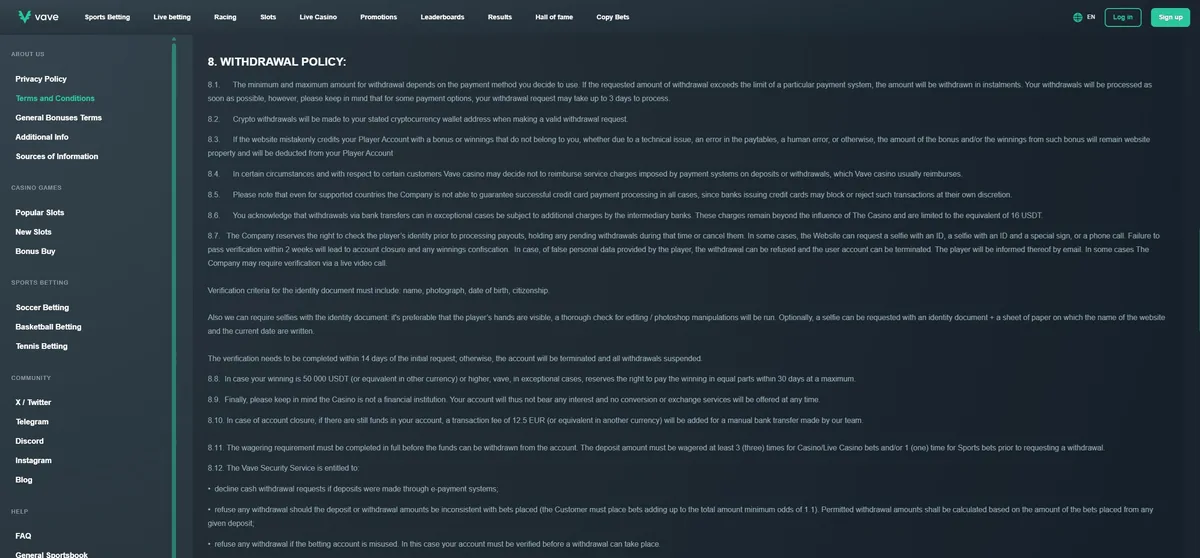
Section 8 of the Vave terms as it stood when it was read on 25 August 2026. Clause 8.7 is the trigger this page records for Vave: an identity check the operator may run before any payout, with fourteen days to comply. The two clauses around it are about when money leaves rather than about identity — 8.8 pays a win of 50,000 USDT or more in instalments over thirty days, 8.11 requires the deposit to be wagered three times first.
Deposit: money arriving is a trigger in one document
Bitsler, clause 8.22. The operator monitors unusual or suspicious transactions and may require additional identification documentation, or proof of where a player's wealth or funds came from, if certain criteria are met at any point — “notably when making large deposits” — or if it is concerned about the player's level of spend. Large is not defined. Read on 2 September 2026.
The same document reserves a wider right at clause 4.3, to authenticate registration details and to comply with anti-money-laundering legislation. Because clause 8.22 names an event, Bitsler is filed with the documents that name a trigger rather than with the two that name nothing — the distinction is set out on the three states page.
Play: a threshold nobody prints, and a check with no trigger at all
Metaspins, clause 9.7. Age verification is always required, and identity verification kicks in “upon your gambling reaching” a threshold the clause never prints, with discretion kept to verify at any time and to lock the account or block withdrawals until identity is confirmed. The operator names the threshold without ever printing it, and that omission is its own wording, not a hole in the reading. Read on 2 September 2026.
Bitcasino.io, clause 3.13. The most interesting entry in this whole record, because it is a trigger that declares itself not to be one. The operator holds the right to run random Account Health Checks, and its own wording is that these are “carried out at random” with no requirement for any prior suspicion or trigger — with access to the account, gameplay features and the ability to deposit or withdraw possibly restricted for the duration of the review. Read on 2 September 2026.
A check that needs no trigger cannot be planned around, and a page that lists triggers has to say so rather than leave the impression that the list is exhaustive.
Withdrawal: where most of the record sits
Bitcasino.io, clause 6.6, reserves additional verification for withdrawals exceeding €2,500 or the equivalent in cryptocurrency, and the same sentence reserves that same right for withdrawals below the figure too. Rocketpot, clause 11.4, names the equivalent of 0.05 BTC or $2,500, and its clause 12.4 names $2,000 for the same purpose. Those are the only amounts printed anywhere in the ten, and they are taken apart on the thresholds page.
Every trigger catalogued above belongs to an operator inside the best anonymous crypto casinos, placed on this line by its own clause rather than by a summary of it.
Vave, clause 8.7, places identity documents at the withdrawal and gives fourteen days to supply them, read on 25 August 2026. Rainbet, clause 20.1, keeps the right to request whatever KYC paperwork it judges necessary for working out who a user is and where, and restricts service, payments, withdrawals and access to funds if verification is not completed within 72 hours. Wild Fortune, clause 11.2, puts a check before processing any withdrawal request, in addition to the BTC gate at clause 2.7.
Payout: the last place a document can put it
Jack.com, clause 12. The company keeps the right to hold a withdrawal back and check identity before releasing it, for as long as that check takes. A separate clause, 10, keeps the same option open at any point in the relationship, not only at payout. Read from a saved copy of that page after the live site failed to load on 2 September 2026; the operator itself dates the underlying terms 2 May 2022.
This is the latest position a trigger can occupy, and it is the position the phrase no KYC is usually promising. Both halves of that document — a form asking for almost nothing, and a clause that keeps identity in reserve for the whole life of the account — are set out on the no KYC crypto casino page.
Triggers that are not about money at all
Two documents make the trigger a property of the player rather than of the transaction. Wild Fortune's clause 2.7 keys on the coin. Jack.com's clause 10 insists on paperwork written in Latin or Cyrillic script, with video verification offered to a player who cannot supply that, which makes the alphabet of a passport into a procedural event.
And several make it a property of the operator's own suspicion. Bitsler's clause 4.3, Rainbet's clause 20.1, Wolfbet's clause 5 §1 and Thunderpick's clause 21.1 all reserve the right to ask on the operator's judgement. The last two name nothing else at all, which is why they are recorded in a box of their own.
What is deliberately absent from this page
No trigger here was observed firing. Nothing on this page is a report of a check that happened to anybody: no account was opened against one of these clauses, no document was submitted, no withdrawal requested to find out which sentence actually operates. The two real-money tests named on the home page were not run for that purpose either. The full list of what was not done is on the method page.
No trigger is inferred from a competitor's page. Where a figure or an event circulates for a brand with no clause standing behind it, this page drops it instead of hedging, and a document that names nothing gets recorded as naming nothing.
And nothing here explains how to stay under a trigger. Describing where a document places a check is a reading of a contract. Arranging an account to avoid one is a different activity, and this site does not cover it. What an operator observes without asking anybody for a document is a separate subject, handled on anonymous is not invisible.